While working with the Rule-based Epidemic Modelling group at the University of Southampton ↗ I began to consider the wider context, outside our core area of studying malaria.
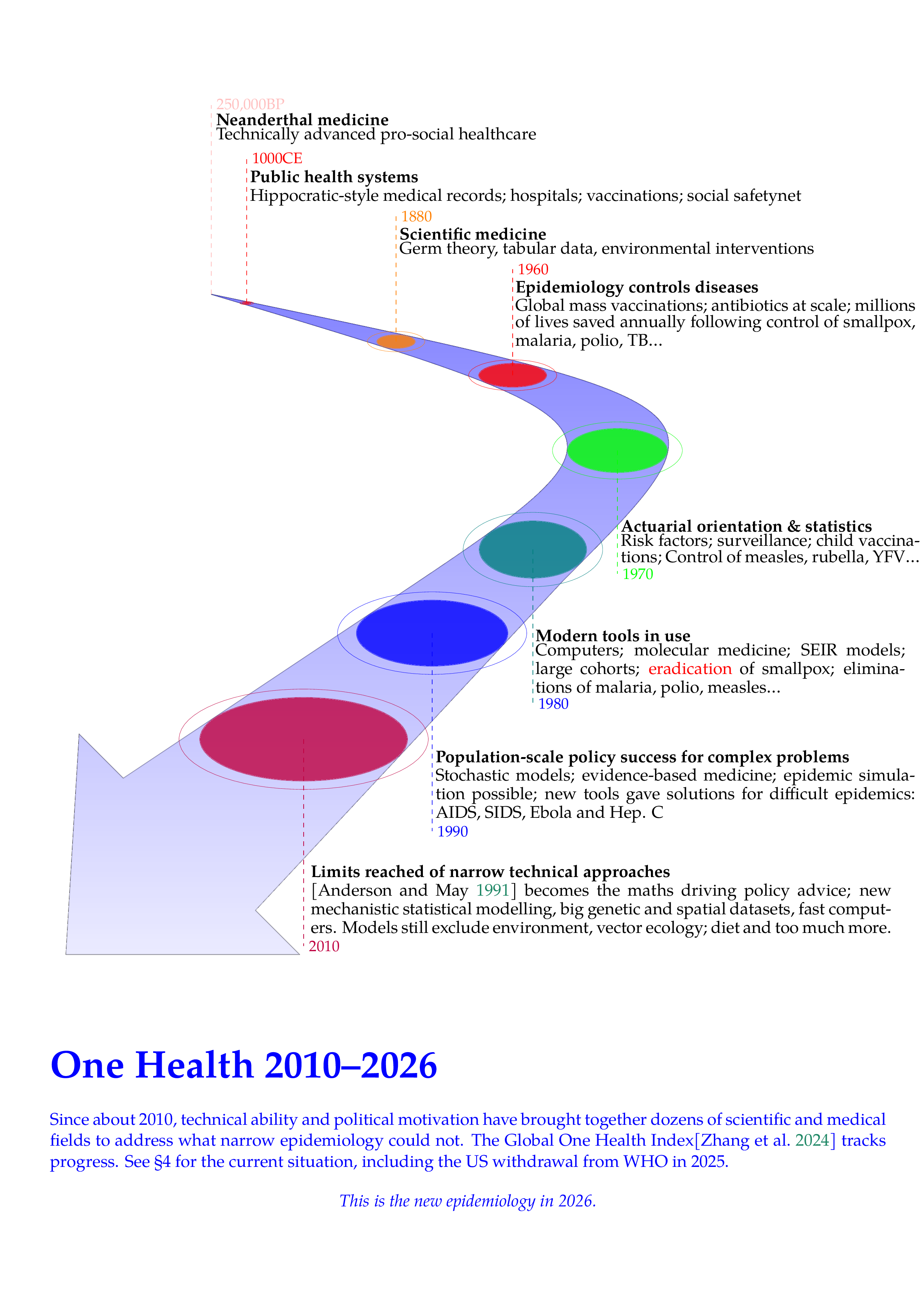
On the one hand, the techniques of epidemiology save lives at scale, but on the other, emerging diseases and newer health-related epidemics are accelerating. It seemed as if the field of epidemiology was really struggling, and indeed that turns out to be true. Most of the world has now adopted a new, holistic and systemic approach to healthcare, called One Health. One Health treats ecology, animals and humans as a system of systems across dozens of science fields, using the language of epidemiology.
One Health involves scholars across the sciences and humanities, besides practical workers in these fields too, and this creates a large problem of communication. It doesn’t make sense for a skilled ecologist, historian or physicist to learn epidemiology, but how are all these fields to communicate with each other about health? So I wrote a paper seeking to answer the question How can a scholar quickly grasp epidemiology basics?
You can download the 2026 paper Discovering Epidemiology.
Beginning with what epidemiology is not, the paper shows how disease management saved millions of lives from about 1950. Epidemiology matured through the 20th century but stalled in the early 21st. It became clear that epidemiology was insufficient, and political consensus was found to expand the scientific scope to One Health. The newly-refocused World Health Organisation is committed to get 2030 global health goals back on track with a One Health approach, with further millions of lives at stake. Many new One Health scientists and scholars are not epidemiologists, and this paper is for them.