The Active Heat Exchanger (AHE) research programme started as an engineering development project, and discovered first an engineering research question and then a health research question. The AHE is a retrofit ventilation device which solves the problem of there being no large-scale, long-term environmental epidemiology data for indoor air quality, despite most humans spending most of their lives indoors. The device addresses the ventilation component of sick housing while generating the continuous surveillance data the field needs.
Here is where we started.
I walked into the Edinburgh Hacklab one day in 2022 and I saw this arrangement of fans and tubes in the window:


This is Awaab Ishak, aged two years, and I could see this device could be a response to the tragedy of Awaab's short life.
Costa Talalaev designed it, and we began to work together.
Two research questions
Having mastered the necessary mathematical topology design and high-precision 3D manufacturing skills, we were able to investigate:
- Is it possible to control for three parameters (humidity, CO2 and temperature) using only fan speed controls? It turns out that a single temperature differential measurement lets you infer airflow rate, and from there a cheap sensor package can manage all three; and
- Can we provide data the scholarship identifies is lacking, in order to make policy decisions relating to indoor air quality and also disease transmission? The sensors the device needs for its own operation generate the continuous, longitudinal indoor air quality data that the field lacks. This has the potential to become a part of preventative health systems and also for active response during incidents of some kinds of disease and airborne pollution.
This is not complete research by any means, but we are well on the way.
This fundamental disconnect between where the people are and where the measurements are made likely leads to misestimation of the true burden of air pollution on human health, which is already substantial, with exposure leading to approximately 6.7 million deaths yearly.
Awaab and housing
Awaab Ishak was two years old when he died of a mould-related illness ↗ in a damp flat in England. His death moved English politicians and from October 2025, Awaab’s Law requires English landlords to fix unhealthy homes ↗.
The World Health Organisation estimates that 20–30 per cent of households in many EU countries ↗ have dampness problems. The UK is particularly exposed, with the oldest housing stock in Europe, probably the world ↗, unsurprising given that 38 per cent of homes were built before 1946 ↗.
47 per cent of English homes have uninsulated walls ↗, and of the roughly 8.5 million homes with solid walls across Britain, around 90 per cent remain uninsulated ↗. Around 7 per cent of UK homes still lack double glazing ↗, mostly the oldest and hardest to retrofit.
From 6 October 2026, the Investigation and Commencement of Repair (Scotland) Regulations 2026 ↗ require private and social landlords who know about damp or mould to investigate within ten working days, give the tenant a written result within three working days, and begin any required work within five. They also require private rented homes to be substantially free from damp and mould.
The legislation follows the Scottish House Condition Survey ↗, which found mould in about one home in ten in 2023, while 861,000 households were fuel poor ↗. Scottish research associates rented housing with more respiratory hospital admissions among young children ↗. In a current Glasgow court case brought by an NHS employee called Tony Blair ↗, a respiratory physician said damp and mould would have contributed significantly to Blair’s recurrent pneumonia, chest infections and worsened asthma if the court accepts that he was exposed.
Heating, insulation and building fabric repairs remain as essential as always. What the AHE adds is retrofit and adaptive control, both difficult, expensive or ineffective in old housing stock.
In a flat like Awaab’s, there are three problems at once:
- make the air warm with heating
- keep the warm air (that you just paid to heat) inside with insulation
- have good air ventilation to the cold outside, without throwing away the warm air
It is normal in the UK to address only one or two of these problems in a retrofit, leaving a health problem. New heating or insulation can reduce bills while worsening damp if adequate ventilation is left out.
The initial solution
The Active Heat Exchanger was conceived when Costa Talalaev, a physicist who runs Makerbee Ltd ↗ in Edinburgh, had what seemed a simple problem: his old flat was damp. He couldn’t afford to tear it apart for ducting, he didn’t want to waste the heating energy he was paying for, and whatever he fitted had to work even with the draughts and leaks that are normal (often by design) in old Scottish buildings.
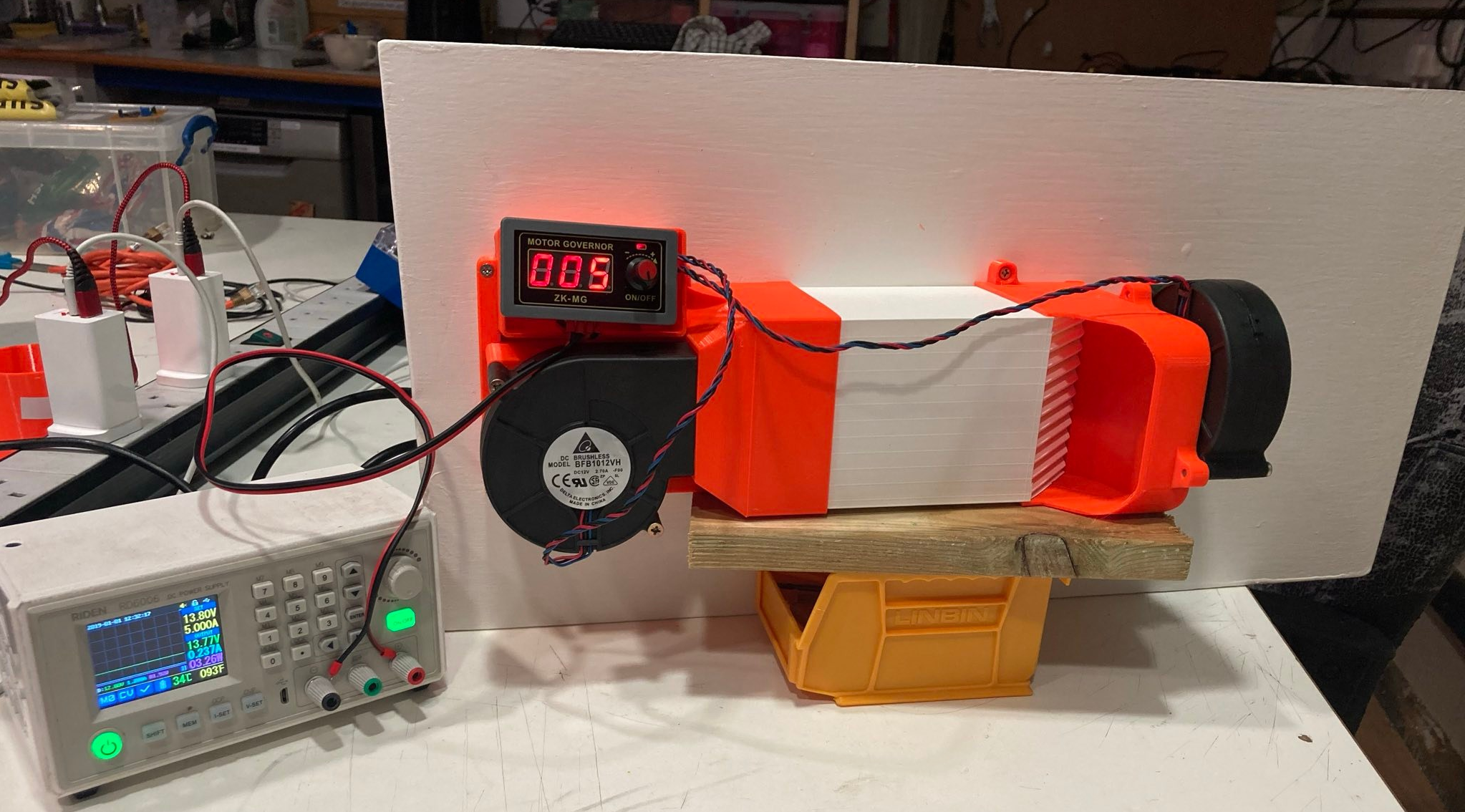
Using 3D printing and his lab measurement tools Costa created an origami-type design which worked for his flat. He then further proved it in the large communal room of the hacklab near his office, where he could monitor temperature and CO2 over the web for months at a time. I saw the prototype running with its monitoring data on a screen, and joined the project on the spot.
Costa also founded Warm Edinburgh, a group of over 1,000 people working on tenement insulation and related problems, so he was hearing from tenants and landlords about humidity and black mould constantly. Existing ventilation solutions are designed for modern, well-sealed buildings with centralised ducting. They are inflexible, expensive, and they assume the building is airtight, which old buildings never are. Costa moved the solution away from mechanical rigidity into three components: cheap and highly controllable fans, intelligent control software, and comprehensive sensors. The result is cheap to produce, and even at hacklab scale the evidence from manufacturing PPE during the pandemic shows we can produce thousands of units per year before outsourcing to a factory for very high volumes.
Before showing where we are today, it helps to look at the principle of heat exchanging.
Traditional Passive Heat Exchange principles
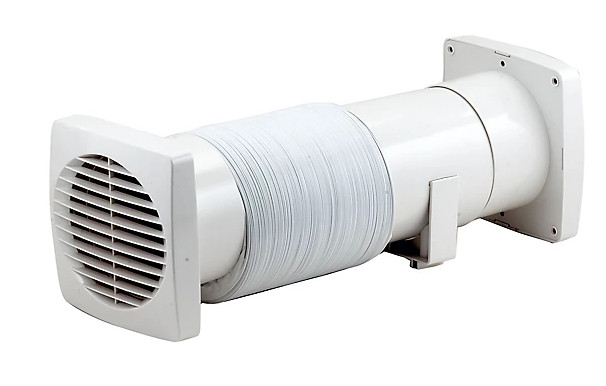
The original Passive Heat Exchanger (PHE) built by Costa is a 30-centimetre box section tube filled with a honeycomb of hundreds of 5mm tubes. A diverter at one end splits the tubes so that half exit one way and half exit the other. You mount the whole thing through a wall, with a small fan at each end. Warm air leaving the building flows out through one set of tubes while cold air from outside flows in through the other set, and because the tube walls are extremely thin (as thin as a sheet of paper), heat transfers through them. The outgoing warm air heats the incoming cold air, so you get fresh air without losing your hot air.
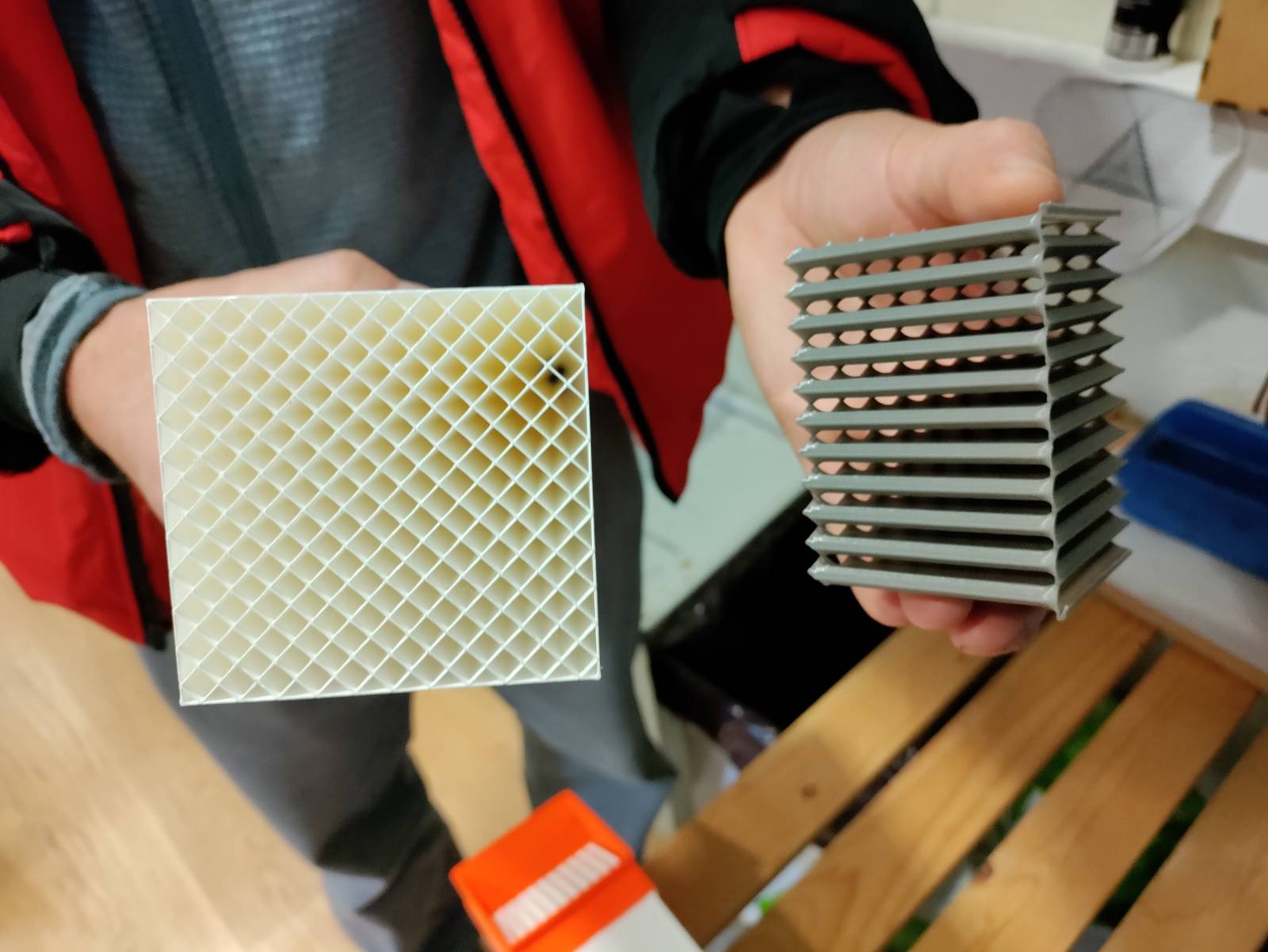
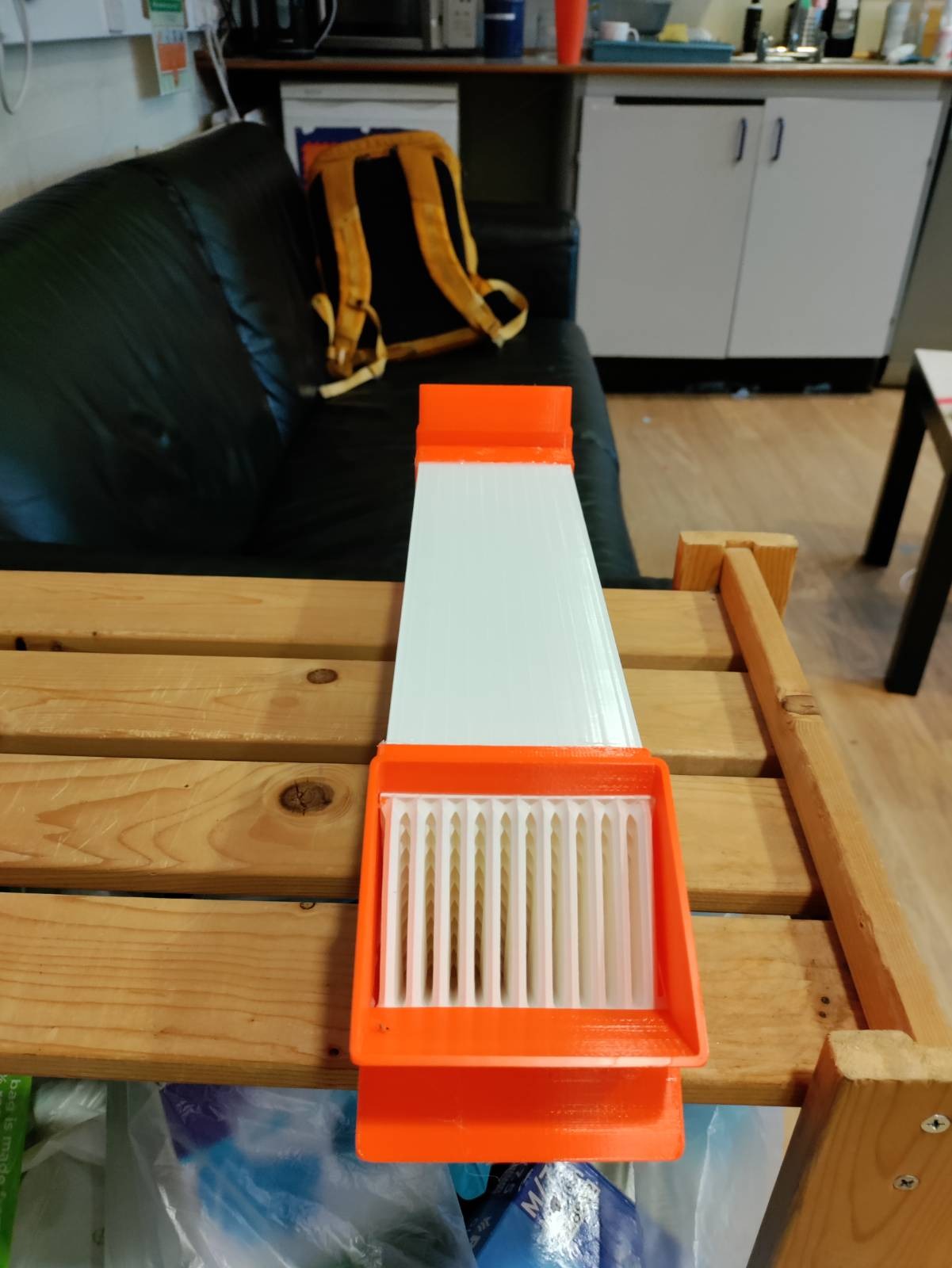
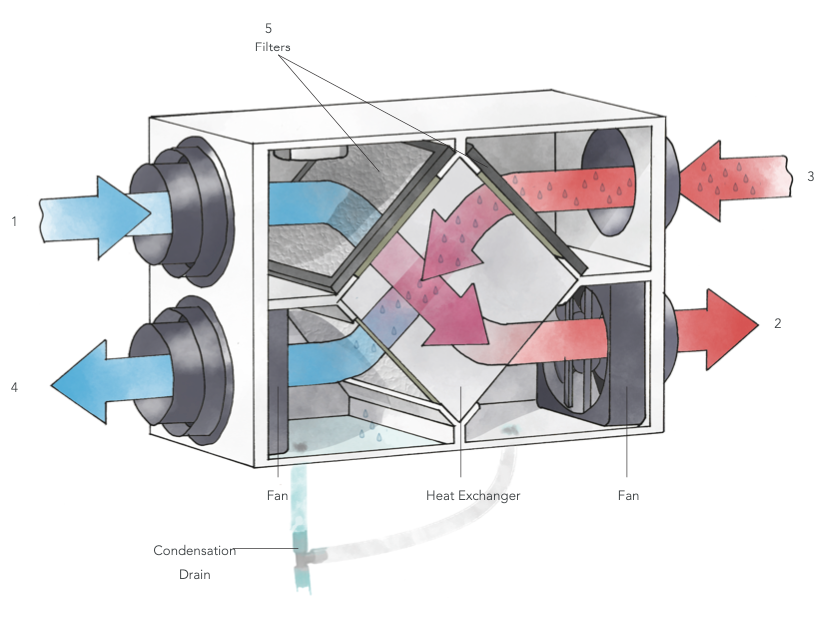
This is the kind of PHE commonly found in German Passivhaus systems, and illustrates the general principle:
What Active Heat Exchange adds
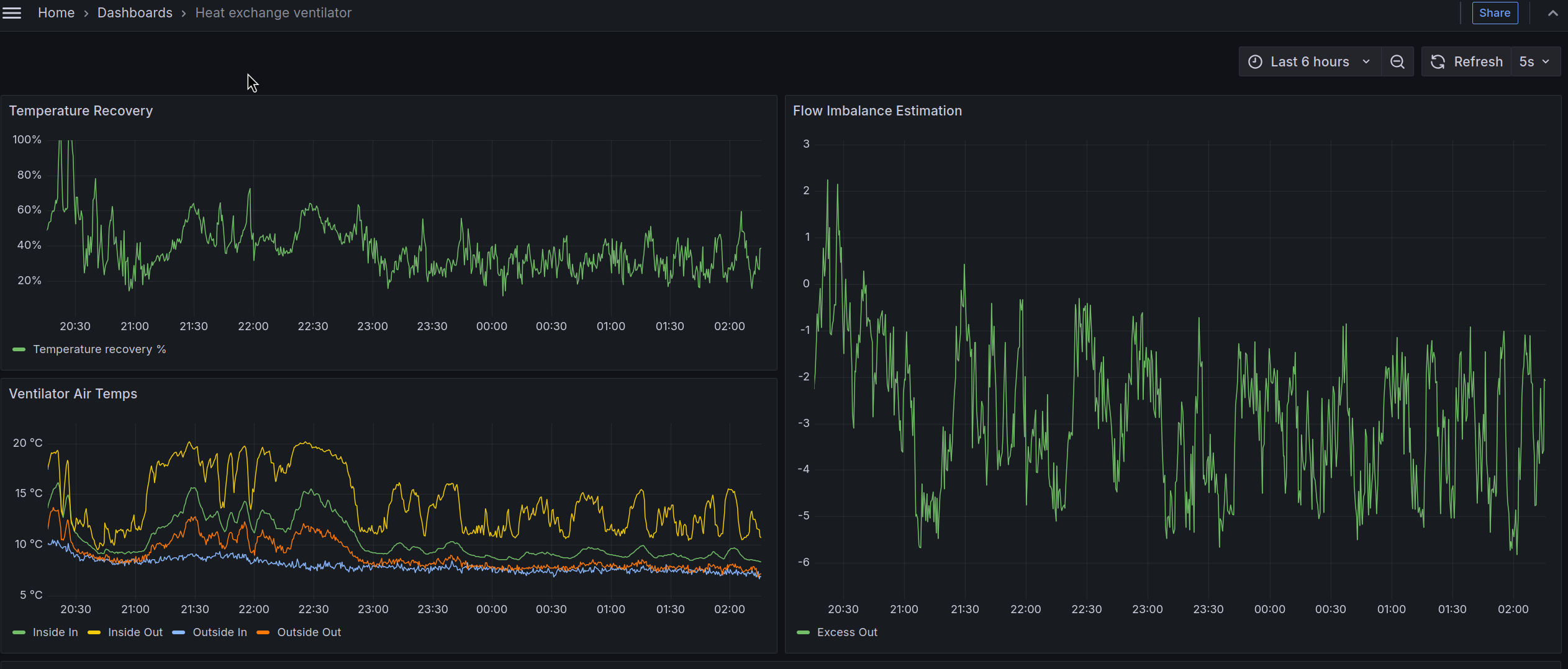
In its simplest, passive form the device runs with constant fan speed and a manual control, a stripped down version of the initial prototype. The Active Heat Exchanger adds IoT sensors and controllable fans, and this is where something clever happens with the physics. Measuring airflow directly in a small tube is very difficult, but there is almost always a temperature difference between the two ends of the exchanger, and Costa worked out that the temperature differential across the exchanger tells you the airflow rate and direction. Heat transfer through the tube walls is proportional to flow, so one cheap temperature measurement replaces a difficult direct airflow measurement. That single measurement from a cheap temperature sensor, combined with humidity and CO2 sensors, gives enough information to manage fan speed, compensate for wind pressure and maintain air quality automatically, all from a unit the size of a bathroom exhaust fan.
Each active unit optimises its own immediate environment using control theory, and by connecting multiples of these intelligent systems they can coordinate their activities for an entire building without needing a traditional centralised computer system.
Improving on the overseas normal
For the last thirty years the German Passivhaus standard ↗ has addressed all three of these problems at once, including a heat recovery ventilation system as the de facto standard. Heat recovery brings in fresh air from the outside, warming it with the stale air as it goes out, with ducting throughout the house. In contrast, the UK updated minimum heat recovery requirements in 2022 ↗, which do not apply to existing homes which need it the most. New build homes can be constructed as a sealed box where it is easy to do heat recovery, whereas old buildings are leaky, never designed for ducting and wind overwhelms ventilation fans and pushes all the heat out through leaks elsewhere. Retrofitting a Victorian tenement to Passivhaus standard means ripping out walls for ducting, sealing a structure that was designed to breathe, and often falling foul of conservation rules. The cost and disruption put it out of reach for the buildings that need it most.
The needs of any building are constantly changing. For example, Carbon Dioxide (CO2) builds up when people are in the room and clears when they leave, humidity spikes when someone showers, and air pressure changes with the weather and wind. Managing these things is easier if the building is a sealed box, but even there it is still a dynamic, changing situation ideally suited to Internet of Things device thinking.
The design we have now fits into a standard 100mm bathroom exhaust hole, exchanges 30 cubic metres of air per hour, and would cost perhaps £300 installed in a home, and you control it from your phone.
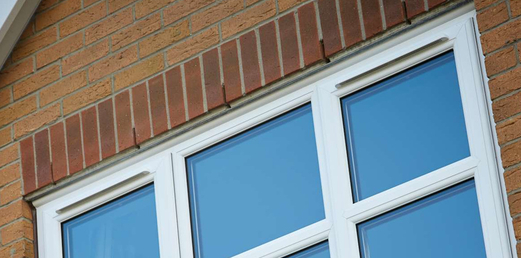
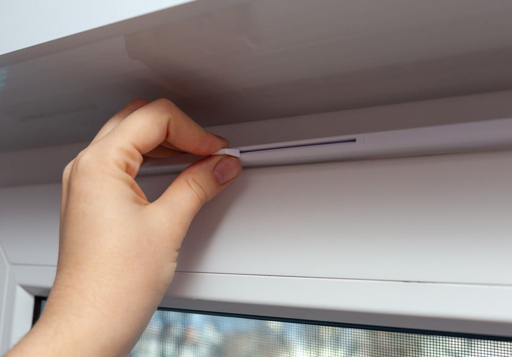
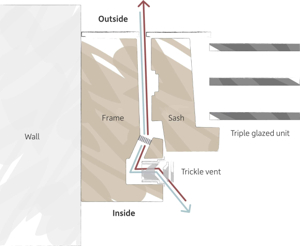
The design we want to make next clips into standard trickle vents as installed in millions of windows. Here is how the trickle vent in your house works today:
Where we know it works
There are some applications that are immediate and obvious, and do not need additional development because we have solved the engineering problem. The PHE is a drop-in replacement for an exhaust fan, fitting into the same 100mm hole. It works in old buildings because it doesn’t depend on the envelope being sealed. It handles wind because the control system adapts. And because the units are small and modular, they fit into spaces that centralised systems can’t reach.
Boats and live-in vans or caravans have serious condensation problems that most people don’t think about until they live aboard or travel in winter. A boat cabin or a campervan with people sleeping in it generates litres of moisture overnight, and without ventilation everything is soaked by morning. The second-generation PHE design fits into a panel mount for exactly this kind of installation, and in vehicles the passive version with constant low-speed fans is usually all you need.
The potential agricultural applications surprised us. In intensive horticulture, plants need CO2 delivery, humidity control, and protection from temperature swings, and growers currently use gas heating for all of this at great expense. In animal husbandry, the needs are different (air drying, dust removal, disease vector control) but the AHE’s ability to manage airflow through narrow tubes suits both. The really interesting possibility is connecting plant and animal controlled environments via AHE, because their atmospheric needs are partly complementary: animals produce CO2 and excess heat that plants can use, while plants produce oxygen. The narrow tubes also make it possible to divert gases through filters, including Zeolite systems that can capture methane. There are additional research questions here, but we have done enough investigation to believe this to be a promising field.
Where we are today
The engineering works. What remains is production engineering and independent validation, and we are working toward both. Costa and I have been developing this since around 2022, and during the pandemic Makerbee demonstrated it could handle manufacturing at scale by producing 53,000 pieces of PPE on 3D printers in the lab. We’re confident the step from low-volume production to mass manufacture via extrusion factories is manageable once we have the design fully validated, but validation takes time and funding.
We still need to improve efficiency per gram of weight, smooth surfaces that meet airflow, add automatic flaps against strong winds, and detect and control for insects and mould spores. We have been testing working units in real occupied spaces for over a year, and the core works well enough that we’re now focused on production engineering rather than proving the concept.
We want to make this cheap enough and simple enough to retrofit that it becomes a normal part of ventilating old buildings, helping prevent mould-related illness alongside adequate heating, insulation and building repairs.
Along the way we noticed the sensors the device needs anyway for its own control (temperature, humidity, CO2) generate data that turns out to be scientifically valuable.
There is no indoor AQ data
The scientific scholarship acknowledges little is known about Indoor Air Quality (IAQ). The US Environmental Protection Agency has no monitoring network routinely measuring IAQ ↗. The UK Parliamentary science office concluded in 2023 there are gaps in IAQ research around airflow and pollutant accumulation ↗. A review of two decades of research found a lack of IAQ studies covering both residential and commercial environments ↗. Those that do exist are mostly brief snapshots of single rooms, what the literature calls short-term monitoring bias ↗.
Outdoor AQ is monitored to reasonable degree in many countries. In Scotland, the entire air quality network ↗ measures ambient street-level pollution at fixed sites. The EU’s revised Ambient Air Quality Directive, in force since December 2024, strengthened outdoor monitoring ↗ but left indoor air outside its scope entirely. The EU’s SINPHONIE and OFFICAIR field campaigns ↗ measured indoor pollutants in schools and offices across member states, but these were time-limited research projects.
The reason is cost, or at least that was the case until recent advances in reliable Internet of Things monitoring devices. Every indoor setting is unique in layout, occupancy, leaks, heating and more, so useful data requires sensors in at least thousands of dwellings. For damp and ventilation the variables should be at least CO2, humidity, and airflow rate. These are rarely measured together continuously in occupied dwellings ↗. With these measurements we can detect flats like Aweeb’s, and track which interventions work over time.
The active PHE has control logic which requires continuous measurement of temperature differential, humidity, CO2, and inferred airflow as its basic functioning mechanism. A network of deployed units would generate the lacking large-scale, long-term residential dataset ↗.
CO2 and infection
Every breath you exhale contains CO2, and so does every virus-laden aerosol an infected person releases into a room. CO2 concentration is a practical proxy for the fraction of air in a room that has recently been inside someone else’s lungs, and therefore for how likely you are to inhale what someone ill exhaled a few minutes ago.
The use of CO2 as a ventilation indicator dates to the 19th century ↗, but it was formalised into infection risk modelling through the Wells-Riley model of airborne transmission ↗, which shows that the likelihood of inhaling an infectious dose scales with the concentration of rebreathed air. During COVID this became practical public health guidance. The UK SAGE advised that spaces with aerosol-generating activity should maintain CO2 below 800ppm ↗, and that CO2 measurements could be used directly to infer airborne infection risk.
Research in Nature Communications presented and unexpected result: elevated CO2 at around 800ppm increases the aerostability of the virus itself ↗, making airborne SARS-CoV-2 more infectious, so for this particular virus CO2 is a contributing factor to risk as well as a proxy for it. From this Nature article I have a hypothesis of how the AHE might have an impact.
The UK government distributed more than 386,000 CO2 monitors to state-funded schools ↗. Research monitoring 36 naturally ventilated classrooms found that airborne infection risks in winter were roughly double those in summer ↗ due to closed windows.
Then as COVID receded and energy costs rose, most schools stopped monitoring ↗. By late 2022 only 26% of classrooms were still tracking CO2.
So: overall, the pandemic established that ventilation is an infection-control intervention, and that CO2 is a practical tool for managing it in real time. A network of active PHEs, continuously measuring CO2 as part of their normal operation would be permanent public health infrastructure.
So what next?
We need to develop the data systems and deploy the Active Heat Exchanger to several hundred buildings, ideally a mix of homes and schools. This would give us enough information to refine the concept for larger-scale rollouts.
If you are interested, let us know ↗. This is our passion project, but these vital topics of health and well-being should matter to local authorities in many parts of the world, and certainly in Scotland.