The COVID-19 virus family is full of surprises, all of them bad. This note briefly summarises one of the most surprising features, and my hypothesis concerning this feature.
Here are the three basic facts:
- We breathe out more CO2 than we breathe in, and so the more exhaled breath there is in a room, the more CO2 there will be.
- During COVID-19 this became a practical way to find rooms where ventilation was failing and airborne infection risk was rising.
- A 2024 Nature Communications paper ↗ found that in laboratory aerosols, moderately elevated CO2 also helped SARS-CoV-2 remain infectious.
In other words, the virus prefers stale air - a big warning for us all to get outside and/or inhabit well-ventilated buildings.
My speculative hypothesis
Our Active Heat Exchanger changes the air in a room up to several times an hour in order to reduce CO2, among other things. If adopted at scale, this might exert evolutionary pressure on COVID-19 and other pathogens with similar aerostability properties in the presence of CO2. If so, this could have a protective effect on the less well-off and the less-healthy on average, since these populations are strongly correlated with poorer indoor air quality including elevated CO2.
In this case, the Active Heat Exchanger would benefit even people who do not have one installed.
More about the Nature study
Allen Haddrell and colleagues found that after an infected person exhales a respiratory droplet, carbon dioxide leaves it for the surrounding air. That alters the droplet’s bicarbonate chemistry, raises its pH and reduces the infectivity of SARS-CoV-2. More CO2 in the surrounding air limits that change, so the virus remains infectious for longer.
The effect appeared at 800 parts per million (common indoors) and was stronger than the effect of changing relative humidity. The researchers tested SARS-CoV-2 variants and concluded there is a physical mechanism.
The study does not give evidence that SARS-CoV-2 evolved to prefer high-CO2 air, just that ambient CO2 protects the virus through aerosol chemistry. It also raises the possibility of other viruses having a similar mechanism.
Historical note on CO2 measures
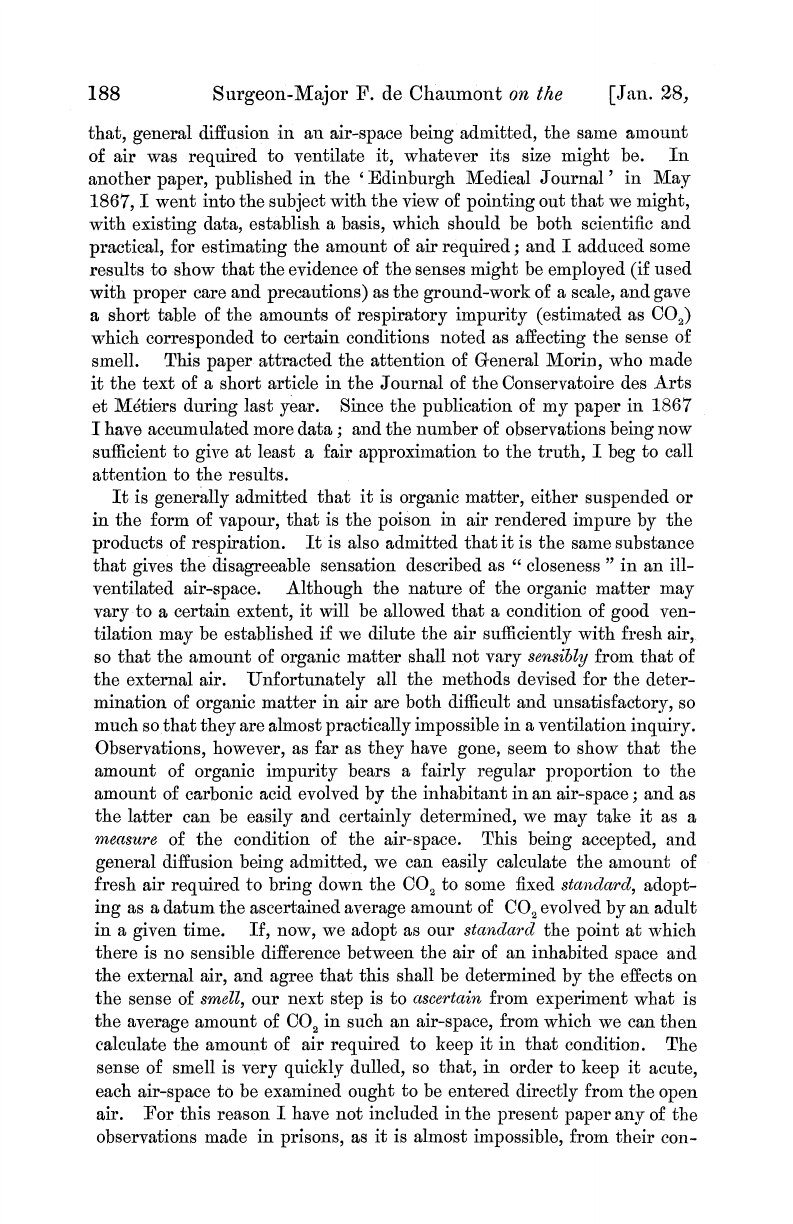
In an 1874 paper, the military doctor F. de Chaumont recalled publishing in the Edinburgh Medical Journal in May 1867:
The determination of the carbonic acid affords us a tolerably close approximation to the amount of respiratory impurity […] and may be taken as an index of the others.
“Carbonic acid” here means the carbon dioxide in room air. De Chaumont was explicit that CO2 was an index: people exhale CO2 along with the moisture, organic matter and other products of respiration that he was concerned about, and these can be estimated by measuring CO2. His paper tried to turn that index into a basis for ventilation standards ↗.
In 2003, S. N. Rudnick and D. K. Milton used indoor CO2 to estimate the fraction of inhaled air previously exhaled by somebody else ↗, and from that the risk of airborne infection. In 2021, Zhe Peng and José L. Jiménez adapted the approach to different indoor settings and activities during the COVID-19 pandemic ↗.