Random humans and computers
Humans are terrible at randomness. If you ask people to write down a list of random numbers the result can usually be shown to not be random at all. Stage magicians and marketing experts exploit our inability to assess how random an event is.
But computers, surely they should be random? It sure feels like it when your printer jams. But no, computers are often worse than humans at being random, and that’s a problem. Randomness is exceedingly important to making computers and networks work.
Random numbers are needed for good cryptography, and good cryptography matters for fundamental human rights reasons. Without it, nothing can be kept private. That is why the EU has built its privacy legislation on human rights. And that is why the random number service at random.org is important, because it suggests (but does not show) how to do this correctly in a mathematical sense.
An unworkable idea in 1986
When I was 15 years old my loving parents bought the family a Unitron 2200 Apple ][ clone because computers do seem like they are going to be important in the future (they got that right, among many other things.) I started to get into computing and somewhere picked up the idea that randomness was important.
![Unitron 2200 Apple ][ clone](/files/unitron-u2200-clone.png)
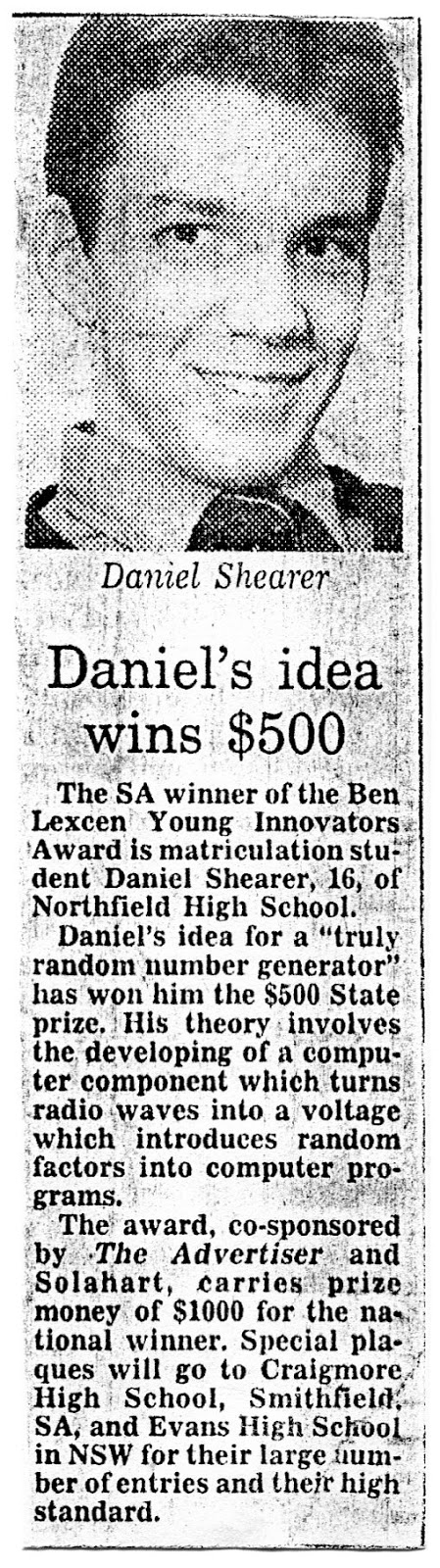
And so, in the department of “ancient things found in the attic”, here is a clipping from the Adelaide Advertiser in Australia. In 1986 I hadn’t the slightest idea how important random numbers were, but they seemed fun at the time. Back then, I just wanted to do better than what a basic IBM PC would produce if you asked it to run a pseudo-random number generator.
Unfortunately no, a random number generator based on mashing together multiple radio stations won’t work. Radio waves of the kind used in analogue radios aren’t truly random no matter how much we confuse the voices with the music! There are mathematical ways to show that, and for various reasons is an important problem to solve.
Dr Mads Haahr of Dublin has all the right mathematics to assess what is a good source of randomness, and I was gratified to discover that much more recently he too looked to the air for his solution, but he chose to use static. “The first version of the random number generator was based on a $10 radio receiver from Radio Shack.”.
Dr Haahr founded Random.org to produce high-quality random numbers for “holding drawings, lotteries and sweepstakes, to drive online games, for scientific applications and for art and music.” The theory behind his work is important for all random numbers. Since the topic of random numbers immediately brings up security, I need to point out that random.org is a single source of failure, and since the source code is not published it is not easily possible to verify Dr Haahr’s claims of randomness (it could, for all we know, be a clever fake that slightly weights the random numbers this way or that, to the long-term benefit of whoever did the weighting.)
$500 for the sake of it
However - the radio waves did get me $500 at the time without actually doing a thing except handwriting a letter enclosing my top 10 ideas, and a confusing conversation with a journalist who found the concept very strange indeed. And perhaps that was something to do with one of the things that happened next.